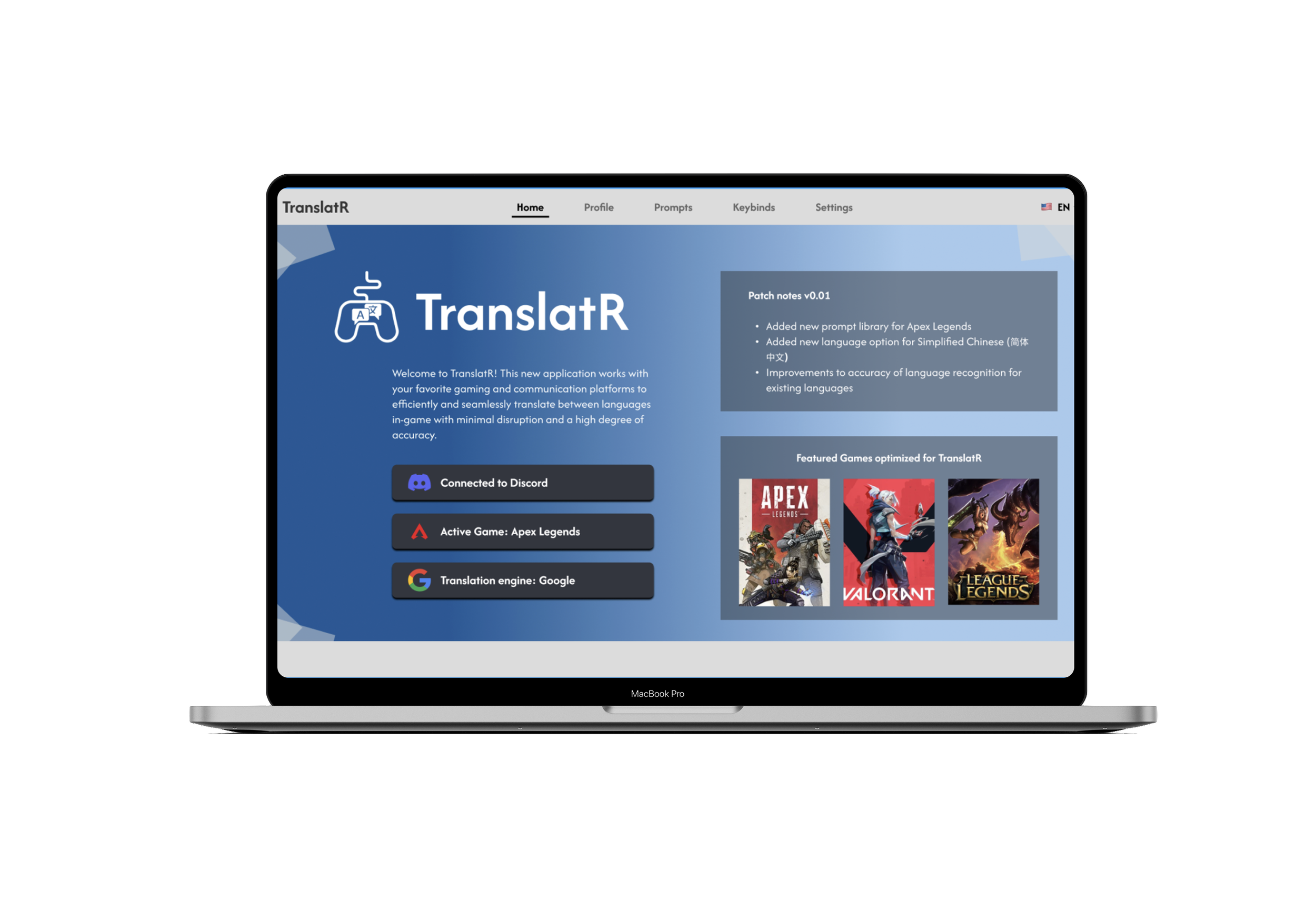
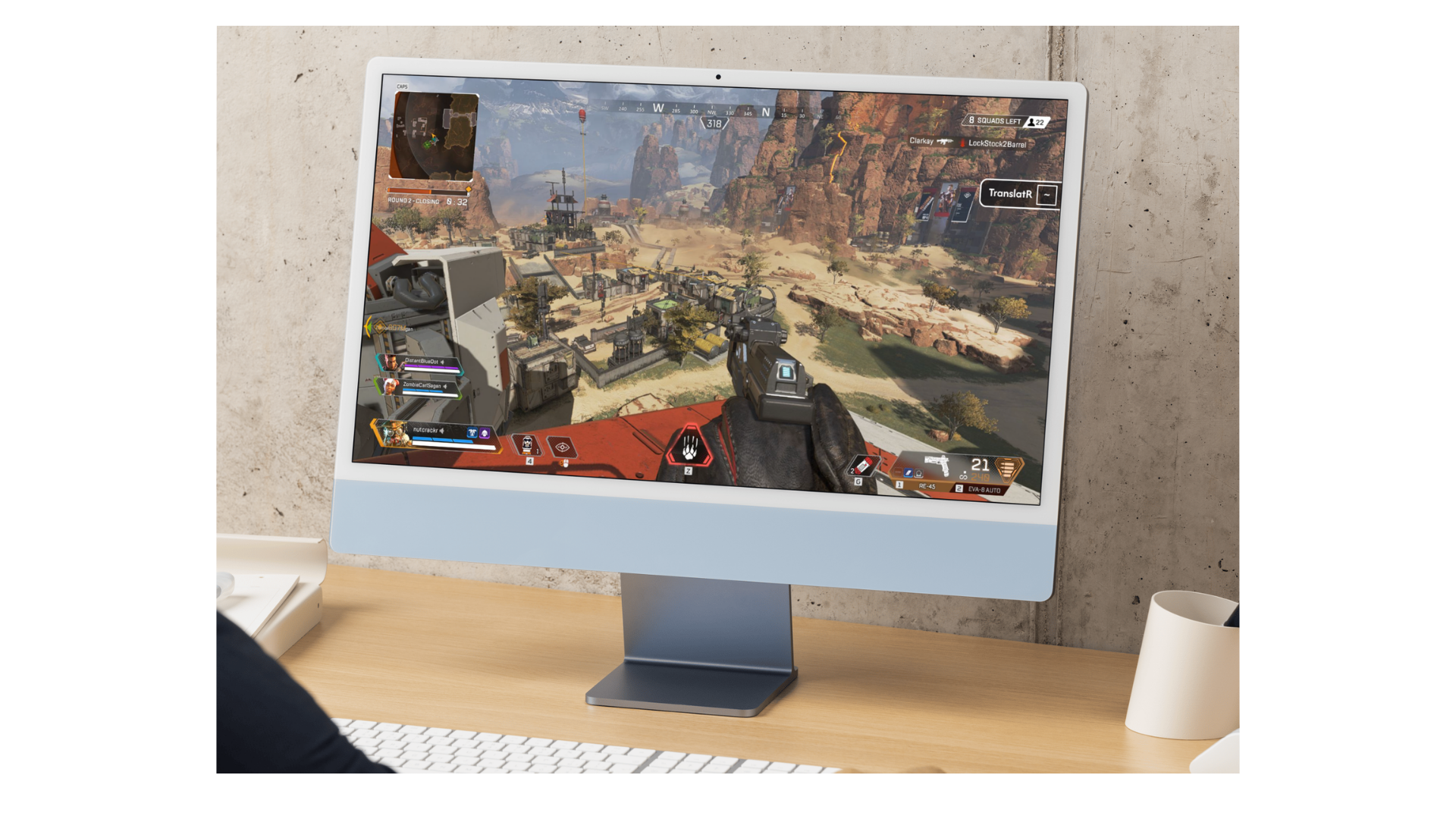
Translatr is a real-time translation app for multiplayer gaming that enables seamless text and voice communication, breaking language barriers for global play.
Roles
Research, Product Design,
UX/UI Design, Wireframing, Prototyping
Product Overview
Team
Aaron Cappuccio (Primary Designer)
Ana Algarvio Alves
Isaac Tan
Yang-Kai (Andy) Hsieh
Timeline
October - December 2024
Hours Contributed: 50
Tools
Figma
Miro
Project Brief
This project was part of an open-ended design course, where we were given the freedom to explore and define our own problem space. We chose to focus on improving real-time communication in multilingual multiplayer gaming environments.
The objective was to conduct user research, analyze existing solutions, and design a user-centered system that addresses the challenges players face when communicating across language barriers. The project emphasized identifying meaningful opportunities for innovation and developing a solution that is both practical and grounded in real user needs.
The final outcome is a prototype that demonstrates how integrated, real-time translation and streamlined interaction design can support faster, clearer, and more inclusive communication during gameplay.
The Problem
Multiplayer online games often require fast, coordinated communication between players. However, in global gaming environments, language barriers make this difficult. Players frequently rely on English as a shared language, which can exclude non-fluent speakers and lead to miscommunication.
Existing solutions, such as external translation tools, are not designed for real-time use. They interrupt gameplay, lack contextual understanding, and fail to support fast-paced interactions. As a result, players experience frustration, reduced teamwork, and in some cases, avoid communication altogether.
This project explores how real-time, context-aware translation can be integrated directly into the gaming experience to support more effective and inclusive communication.
Context
Competitor Analysis
To understand the current landscape, I analyzed platforms such as Discord, Apex Legends, League of Legends, and Google Translate.
These tools support communication through text, voice, or visual systems like pings. While effective for basic interaction, they present several limitations:
Lack of real-time, context-aware translation
Disruption of gameplay when using external tools
Limited ability to communicate complex strategies
No visibility into other players’ language preferences
While systems like ping wheels are efficient, they are too limited for nuanced communication. Conversely, text and voice chat allow complexity but fail in multilingual contexts.
This revealed a clear gap: there is no integrated solution that enables fast, flexible, and multilingual communication within gameplay itself.
Research & Discovery
Research Goals
Understand how players communicate across language barriers
Identify limitations in current communication tools
Explore how these challenges impact gameplay and teamwork
Methodology
Semi-structured interviews were conducted with 10 participants aged 21–30 who regularly engage in multiplayer games involving cross-language interaction. Each session lasted approximately 30–45 minutes.
Key challenges identified
Accents and game-specific jargon leads to confusion and slower communication.
External translation tools were rarely used due to their disruption of gameplay.
Language barriers led to frustration, with some players avoiding communication
Discord
A widely used platform for voice and text communication. While flexible and feature-rich, it lacks built-in real-time translation, requiring external bots or tools that are not consistently reliable or integrated into gameplay.
League of Legends (Ping System)
Provides fast, intuitive communication through predefined pings that automatically translate across languages. However, it is limited to simple, reaction-based messages and cannot support complex strategies or detailed communication.
Apex Legends (Ping System)
Offers an advanced ping system with contextual voice lines and subtitles that adapt to user language settings. While effective for quick coordination, it still lacks the ability to convey nuanced or strategic communication.
Google Translate
Supports real-time text and voice translation, but is not designed for gaming environments. It lacks contextual awareness of game-specific language and disrupts gameplay due to the need to switch between applications.
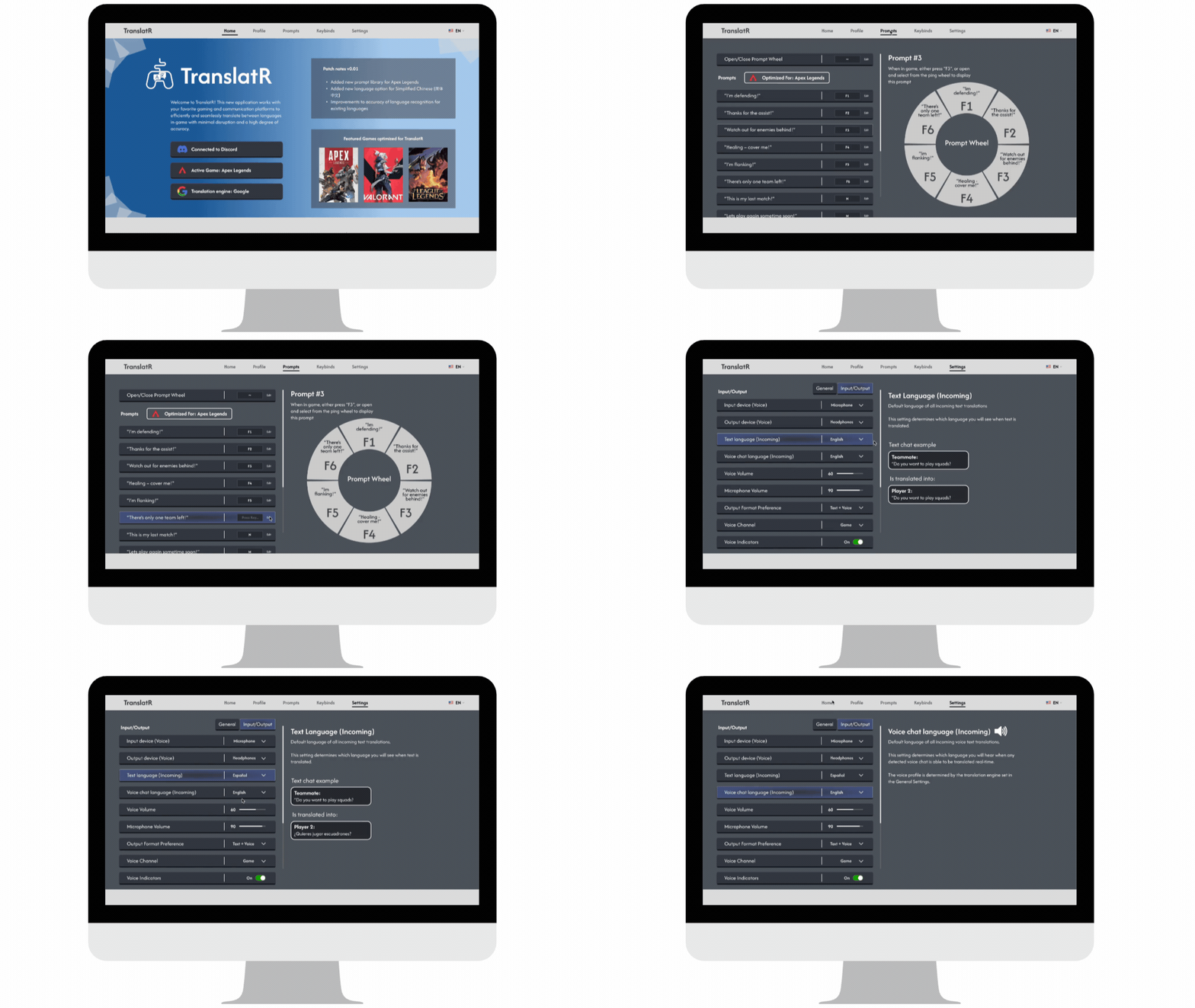
Pictured above: App Launch Screen → Prompts → Settings → Change Incoming Language
Seamless Background Integration
Runs alongside gameplay and integrates with platforms like Discord, eliminating the need to switch between apps.
Real-Time Voice & Text Translation
Automatically translates incoming and outgoing communication, allowing players to speak naturally without worrying about language barriers.
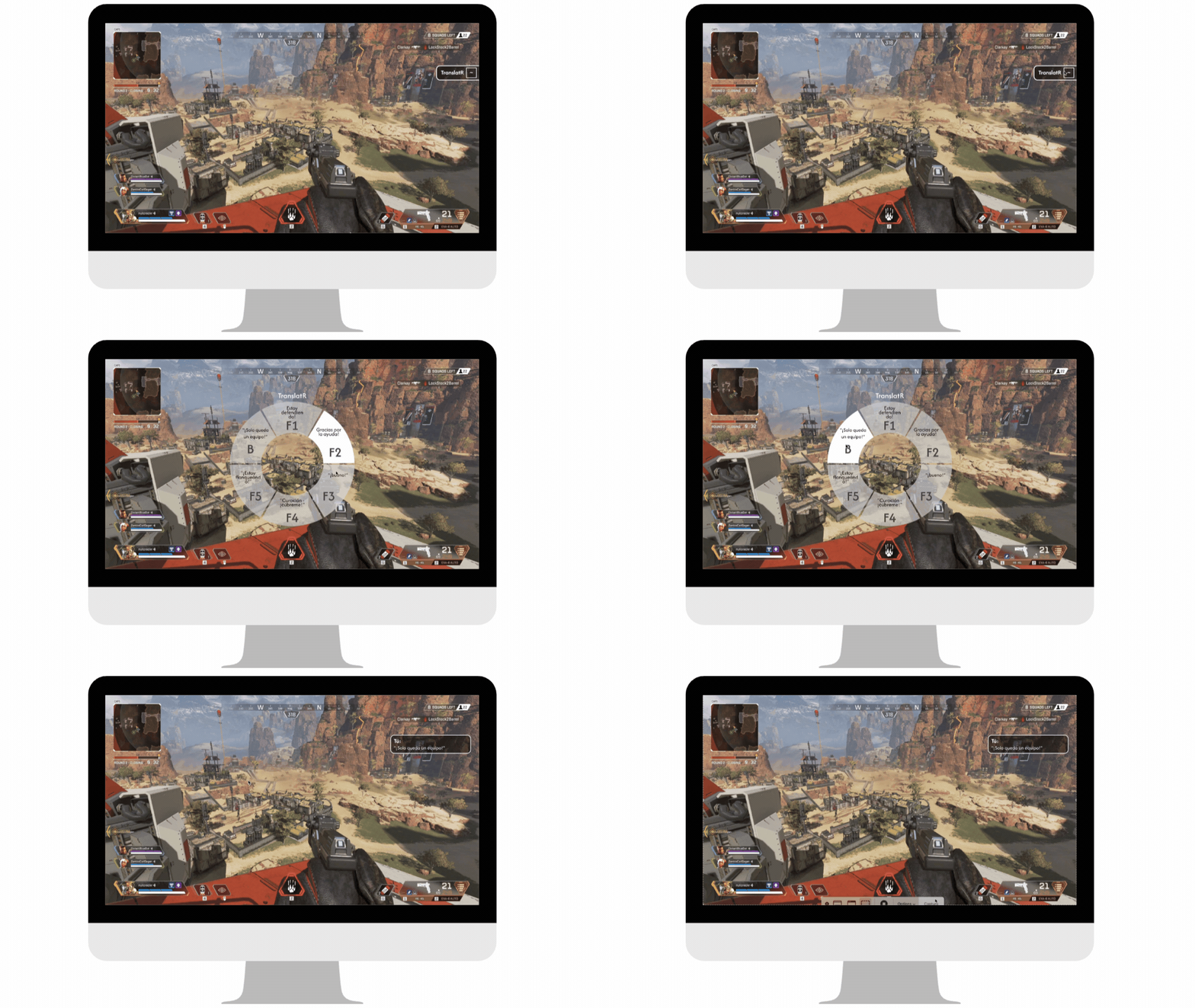
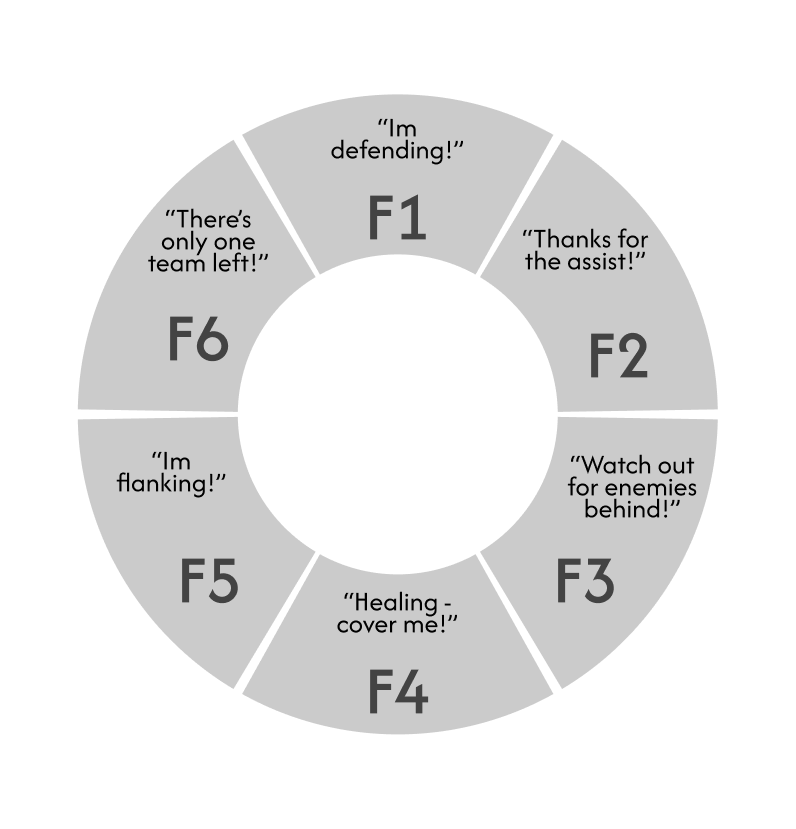
In Game Prompt Wheel
A radial menu that lets players quickly select and send pre-set, translated phrases during gameplay without breaking flow.
Prototype
Game Context Detection
Recognizes the active game and adapts translations to better match game-specific terms and situations.
Custom Prompt System
Users can create and bind common phrases to hotkeys or a prompt wheel for quick, translated communication during gameplay.
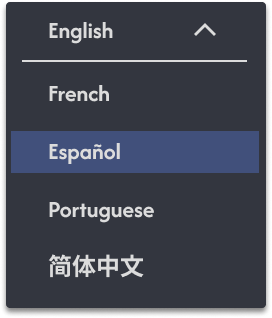
Language Preference Settings
Allows users to customize how they send and receive translations for a more personalized experience.
Design System
Prompt Wheel Component
The prompt wheel is a core interaction component designed for in-game communication. It provides a radial layout of pre-set phrases that users can quickly access during gameplay.
Structure: Radial menu divided into equal segments
Interaction: Each segment is mapped to a keybind for fast selection
Content: Displays short, actionable phrases for common in-game scenarios
Purpose: Reduces reliance on typing while maintaining expressive communication
The circular layout supports quick visual scanning and muscle memory, allowing users to recognize and trigger commands efficiently. This design balances speed and clarity, making it well-suited for fast-paced environments where traditional input methods are too slow.
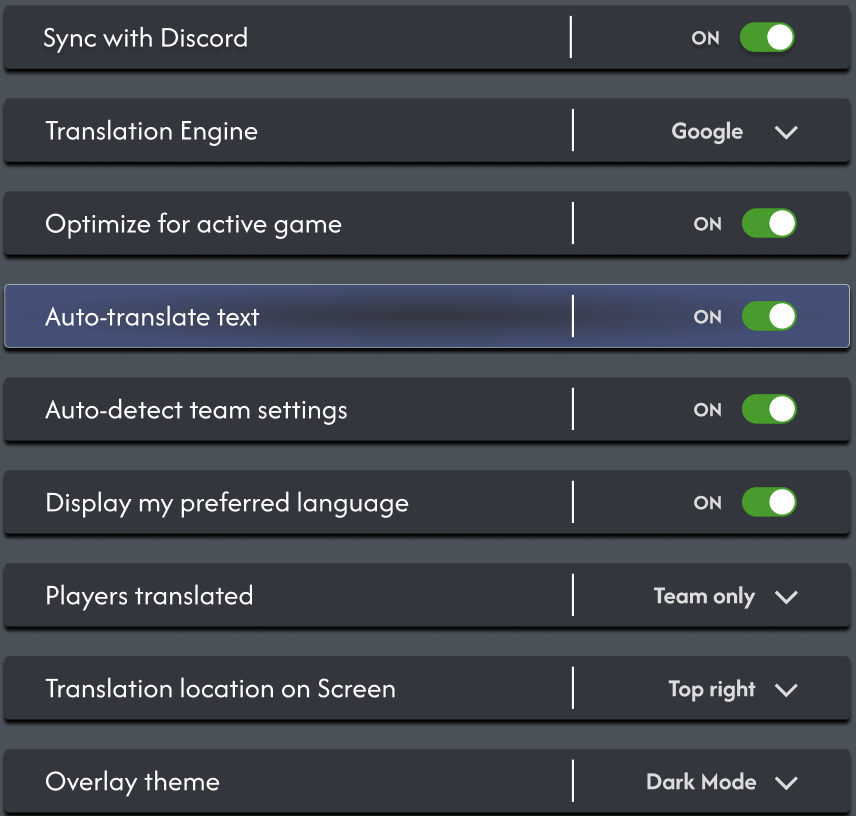
Menu Bar and Toggle Component
The menu bar serves as a structured container for key settings and system controls, with the toggle component embedded for quick adjustments. Together, they create a clear and efficient way for users to manage features without disrupting their workflow.
Structure: Horizontal layout with label, divider, and toggle control
Toggle States: On / Off with clear visual differentiation
Visual Feedback: Color change and switch position indicate system status instantly
Labeling: Descriptive text (e.g., “Optimize for Active Game”) provides clear context
Hierarchy: Divider separates information from interaction, improving readability
Use Case: Enables users to quickly enable or disable features within a clean, organized settings interface
Key Takeaways
Balancing Simplicity and Expressiveness
A key challenge was finding the balance between fast, simple interactions (like pings) and more expressive communication. Features like the prompt wheel demonstrate how structured inputs can enable both speed and clarity without overwhelming the user.
Context-Aware Communication
Designing Translatr emphasized how critical context is in communication. Translation alone is not enough—systems must account for game-specific language, player intent, and real-time conditions to be effective.
Designing for Real-Time Environments
This project highlighted the importance of speed and efficiency when designing for fast-paced interactions. Every feature needed to minimize friction and support immediate communication without disrupting gameplay.